A common misconception is, that crowded teeth are simply a matter of heredity.
Would you have thought that, in the vast majority of cases, crooked, crowded teeth are not caused by genes inherited from our ancestors, but by the Is our modern, civilised way of life to blame?
WMN is popular Give it your all podcast During the broadcast of her programme, presenter Anna Eszter Szabó, Mariann Peller and Dr Sarolta Kovács, an orthodontist, explored the topic in an unusually candid, taboo-breaking discussion.
The conversation revealed not only why the world’s population is struggling today, but also the astonishing 80% It is not just a matter of some dental or bite abnormality, but also the fact that behind what appears to be a simple aesthetic issue lie interrelationships that actually determine quality of life, sleep, nervous system development and posture.
Watch the full conversation on the WMN channel!
Have you watched the video? Don’t miss the next instalment!
If, as a parent, you want to recognise the warning signs in your child – from an open-mouth posture to difficulties with tooth replacement – and would like to prevent the need for major surgery later on or the high costs of orthodontic treatment, join Dr Sarolta Kovács’s online talk!
- Date: 5 November (Thursday), 7.00 pm
- Format: Live online presentation with a Q&A session
- Participation: It’s completely free, but you need to register in advance
Have you watched the video? Don’t miss the next instalment!
From „plaster” traumas to 3D design: How much has orthodontics changed?
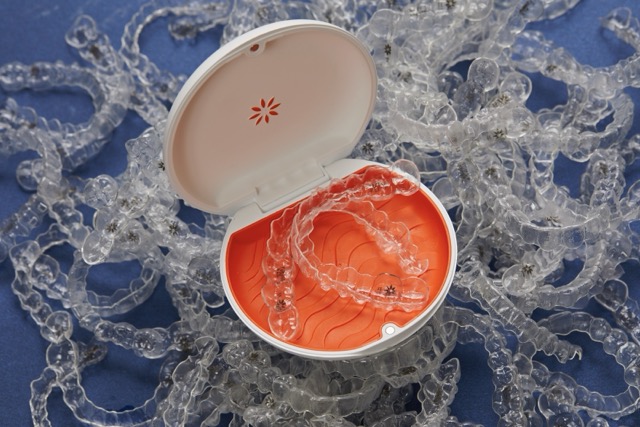
The programme kicked off straight away with a daring live demonstration: Anna Eszter Szabó, with an elegant movement, snapped her almost invisible removable aligner out of her mouth in a matter of seconds, dispelling the decades-old stereotype that orthodontic treatment is synonymous with teasing and excruciating pain.
As the nostalgic reminiscences unfolded, it quickly became clear that childhood orthodontic treatment had left a deep impression on almost everyone in the 30–40 age group. Mariann Peller recalled the days-long aching that accompanied the monthly tightening of her metal braces, as well as the constant mouth sores, whilst Anna mentioned the infamous He mentioned the imprinting spoon:
„I remember that particular fitting, when they pressed that cold, putty-like stuff onto my teeth. I hated it. It made me feel sick, and then I was given a night-time appliance that I had to wear during the day as well. It had a Winnie-the-Pooh design, it was sparkly, and when I had to report to the class as the representative for Year 7, I was mortified.”
„He inherited his father’s teeth” – Debunking the genetic myth
One of the most common explanations for crowded teeth is: „The child inherited a narrow jaw from his mum and large teeth from his dad, so they don’t fit.” According to Dr Sarolta Kovács This explanation is scientifically untenable:
„Our genetic code is not capable of changing on its own over the course of two generations. For such a significant transformation to take place in human genetics, it would take several hundred thousand years. If we look at the skulls unearthed from ancient excavations, early humans, without exception, had broad jawbones and dentition capable of comfortably accommodating all 32 teeth. If our genes have not changed, then our environment must have changed drastically: our faces simply do not receive the physical stimulation they need to develop properly today.”
But what is this missing physical stimulus? The answer is surprisingly simple: muscle strength and chewing.
Soft foods and a lack of chewing: Why isn’t the jawbone developing?
With the Industrial Revolution and the spread of the modern food industry, the human diet has undergone a radical transformation. Fibrous, coarse foods have been replaced by puréed, processed and refined foods.
As the doctor put it so vividly: if we go into a fast-food restaurant today, we can easily swallow a burger in two or three casual bites. Practically speaking, zero muscle strength We need to expend energy to meet our calorie requirements. In the past, thoroughly chewing seeds, raw root vegetables or dried meat involved hard physical labour.
Bone, on the other hand, is a functional tissue: If it is subjected to pressure, it grows and becomes stronger; if it is not subjected to pressure, it withers or fails to develop properly. If a child does not chew enough hard, raw food (e.g. carrots, celery, turnips, apples), the bony bases of the jaw and upper jaw cannot expand properly.
The role of language: The inner sculptor of the face
Apart from chewing, the most important force shaping the bones is the language. In a natural, anatomically correct resting position, the tongue (including the root) should be gently extended to its full length it must rest against the roof of the mouth.
„When the tongue rests against the roof of the mouth, it exerts a constant inward expanding pressure on the midline. The upper dental arch literally grows around the tongue, creating that wide, harmonious smile we see, for example, in Angelina Jolie. If the tongue is in the correct position, a spacious gap automatically forms, into which the lower dental arch can fit perfectly.” – Dr Sarolta Kovács
However, if the tongue is flaccid (hypotonic) and drops onto the floor of the mouth, there is no internal support for the upper dental arch, whilst the facial muscles are constantly pressing it inwards from the outside.
The result: a narrow, V-shaped upper dental arch, a crossbite and crowding.
Well-intentioned but misguided facial development: Dummies, sippy cups and infancy
Most parents do everything they can for their child’s health, but by overusing aids, they may unwittingly interfere with natural physiological processes.
- Impaired speech function: Prolonged use of a dummy and drinking from a sippy cup physically pushes the tongue down to the floor of the mouth.
- The role of breastfeeding: Babies are born with virtually no jaw so that they can pass through the birth canal. This growth deficit is made up for by the intense muscular effort involved in suckling: the baby has to push its chin forward and create a vacuum, which stimulates the bony growth centres.
- Slow-flow feeding bottles: If bottle-feeding is necessary, it is crucial to choose a slow-flow teat that requires the baby to work actively to feed, rather than the milk simply „flowing down their throat” passively.”
The part of the iceberg below the water: Mouth breathing, sleep disorders and pseudo-ADHD
One of the most striking and important points of the conversation is the There was a link between incorrect breathing and neurological symptoms. When the tongue drops onto the floor of the mouth and the jaw narrows, the cross-sectional area of the upper airways also decreases dramatically. The body compensates: the mouth opens, and chronic mouth breathing sets in.
„We have become a society of chronic mouth-breathers. If we look around on the Underground or in the street, we see loads of people travelling with their mouths open and their heads lolling forward. However, mouth breathing not only ruins your teeth, but also creates a fundamental biological emergency. When a person breathes through their mouth, the brain’s primitive genetic programming thinks a sabre-toothed tiger is coming and that they must flee. The sympathetic nervous system immediately switches to emergency mode.” – Dr Sarolta Kovács
If a child sleeps with their mouth open or snores at night:
- A lack of deep sleep: Due to constant micro-awakenings, the brain is unable to enter the restorative, deep REM phases.
- Chronic oxygen deficiency develops: Fluctuations in blood oxygen levels and impaired carbon dioxide regulation place a strain on the circulatory system.
- Behavioural problems during the day become apparent: Due to shallow sleep, the child will be unfocused, irritable, whingey or even hyperactive the following day. The international literature increasingly reports that in many children, the A diagnosis of ADHD is not, in fact, a neurodevelopmental disorder, but rather the result of untreated nocturnal breathing disorders and sleep deprivation.
Surprising anatomy: The connection between the jaw, posture and the pelvic floor
The human body is not made up of completely separate parts. Muscles and organs are held together by a continuous network of connective tissue known as the fascia.
Dr Sarolta Kovács illustrated this with a vivid example: imagine a wooden giraffe toy with a string attached to the bottom; if we let go of the string and it slackens inside, the whole giraffe collapses. This is exactly how the tone of the jaw and tongue works in our bodies: the Poor head posture and mouth breathing cause the neck to slump forwards, the curvature of the spine to change, and the shoulders to hunch forwards.
Sharing her own experience, Mariann Peller added: based on what she learnt during antenatal classes, tension held in the jaw can directly block the dilation of the pelvis, whilst raising the tongue to the roof of the mouth and relaxing the jaw has been proven to help relax the lower abdominal and pelvic floor muscles.
When should we take our child to a specialist? The „corn teeth” trap
There is still a widespread misconception amongst parents that, that you can wait to see an orthodontist until all your permanent teeth have come through (at the age of 12–14).
According to the doctor, this is a huge mistake:
„Many parents proudly say: ’They had such beautiful, evenly spaced, tightly packed little milk teeth!’ In fact, this is a warning sign. Permanent teeth are twice the size of milk teeth. If there are no noticeable gaps between the milk teeth before they fall out, the permanent teeth simply won’t fit. The ideal window of opportunity is between the ages of 6 and 8, when the bone is still softer: at this stage, the jawbone can be widened without surgery or tooth extraction using functional therapy, speech therapy and simple appliances.”
Even as an adult, however, there is no reason to despair: With modern digital aligners, dental arches can be straightened safely, aesthetically and painlessly at any age.